
About the programme
 What is Interreg?
European Territorial Cooperation (ETC), better known as Interreg, is one of the two goals of the EU Cohesion Policy and provides a framework for the implementation of joint actions and policy exchanges between national, regional and local actors from different Member States.
The overarching objective of European Territorial Cooperation (ETC) is to promote a harmonious economic, social and territorial development of the Union as a whole.
Interreg is built around three strands of cooperation:
Cross-border (Interreg A)
Transnational (Interreg B)
Interregional (Interreg C)
Five programming periods of Interreg have succeeded each other from 1990 onwards.
The Interreg programmes are financed in the framework of the EU Regional Policy, also referred as Cohesion Policy due to its aim to dissolve regional disparities between Europe’s regions. This investment policy consumes around one third of the EU’s budget. It targets all regions and cities in the European Union in order to support job creation, business competitiveness, economic growth, sustainable development, and improve citizens’ quality of life.
A few words about our Programme
The Cooperation Programme “Greece-Bulgaria 2014-2020” was approved by the European Commission on 13/12/2016 by Decision C(2016)8708.
Budget
The total budget (ERDF and national contribution) for the European Territorial Programme “Greece-Bulgaria 2007-2013” is €130,262,835.00 .The total financing consists of €110.723.409,75 (85%) ERDF funding and €19.539.425,25 (15%) national contribution.
Eligible area
The eligible area of the Programme consists of the Region of Eastern Macedonia and Thrace (Prefectures of Evros, Kavala, Xanthi, Rodopi and Drama) and the Region of Central Macedonia (Prefectures of Thessaloniki and Serres) in Greece and the South-Central Planning Region and South-West Planning Region (Districts of Blagoevgrad, Smolyan, Kardjali and Haskovo) in Bulgaria.
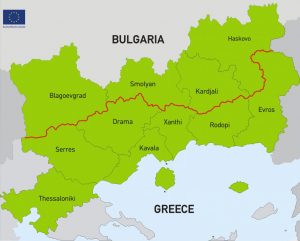
The Greece-Bulgaria cross-border cooperation area for the programming period 2014-2020 is identical to the current ETC programme. It extends to 40.202 km2 and has a total population of 2.7 million inhabitants. It covers four territorial units at NUTS II level (Regions), and 11 territorial units at NUTS III level (Districts). The eligible area extends across the entire Greek-Bulgarian border and is neighbouring with Turkey (east) and FYROM (west), both countries aspiring to access to the EU. It is part of the most south-eastern non-insular area of EU, and it is situated between three seas: the Black Sea, the Mediterranean Sea and the Ionian-Adriatic Sea. Finally, it sits at the crossroad of strategic fossil fuel pipelines supplying the EU market and TEN transport axes.
The settlement structure of the area is characterized by the presence of 10 medium-large cities (>50.000 inhabitants) which accumulate 38,2% of total population, and 25 small cities (10.000-50.000 inhabitants).
Despite the historically relatively small amounts of funds allocated, there is a long history of cooperation in the eligible area, which started with Community initiative INTERREG I (1989-1993).
The priority axes are:
PA 1: A Competitive and Entrepreneurship Promoting Cross-Border Area
PA 2: A Sustainable and climate adaptable Cross-Border area
PA 3: A better interconnected Cross-Border Area
PA 4: A socially inclusive Cross-Border area
PA 5: Technical Assistance
Programme management structures
Please find below a glossary of the management structures of the Cooperation Programme Interreg V-A “Greece-Bulgaria 2014-2020”
The Monitoring Committee (MC) – is consisting of representatives of each participating country – supervises the implementation of the Programme and selects Projects to be financed. Its overall task is to ensure the quality and effectiveness of Programme implementation.
The Managing Authority (MA), assisted by the Joint Secretariat (JS), hosted by the Greek Ministry of Economy and Development, is responsible for the overall Programme implementation. The JS will be the central contact point for potential Project applicants and Project partners.
The Certifying Authority (CA), among other functions, is responsible for drawing up and submitting certified statements of expenditure and applications for payment to the Commission and receiving payments from the Commission. The CA shall use the payments received from the Commission to reimburse the Lead Partners.
The Audit Authority (AA) ensures that audits are carried out on the management and control systems, on an appropriate sample of operations and on the annual accounts. The AA will be assisted by a Group of Auditors (GoA) comprising of representatives from responsible bodies of each Partner State.
First Level Controllers (FLCs) are designated by each Partner State to ensure the compliance of expenditure incurred by project partners on national level with Community and national rules, by carrying out appropriate verifications, covering administrative, financial, technical and physical aspects of operations. Controllers shall be nominated in line with the national provisions of each Partner State. Each country participating in the Programme is responsible for verifications carried out on its territory.
National Contact Points (NCPs) are set up by each participating country to complement transnational activities of the MA and the JS by involving stakeholders from the national level. NCPs hold the Programme’s coordination role on the territory of the participating countries.
The Lead Benefiaciaries (LB) located in one of the Programme’s Partner States are designated by all the beneficiaries participating in a Project to assume responsibility for ensuring implementation of the entire Project (including the arrangements for recovering amounts unduly paid); furthermore for ensuring that the expenditure presented by other beneficiaries has been incurred and corresponds to the activities agreed between all the beneficiaries, that it has been verified by a controller, and that the other beneficiaries receive the total amount of the contribution from the EU funds.
Contact Information
Managing Authority of European Territorial Cooperation Programmes
65, Leoforos Georgikis Scholis, 57001, Thessaloniki, Greece
Tel: +30 2310 469600
Fax +30 2310 469602
Email: interreg@mou.gr
Website: www.interreg.gr
Twitter: @etc_interreg
Youtube: Grinterreg
Joint Secretariat Interreg V-A “Greece-Bulgaria 2014-2020”
65, Leoforos Georgikis Scholis, 57001, Thessaloniki, Greece
Tel: +30 2310 469695
Fax: +30 2310 469623
Email: jts_grbg@mou.gr
Website: www.greece-bulgaria.eu